Background and objectives of the project
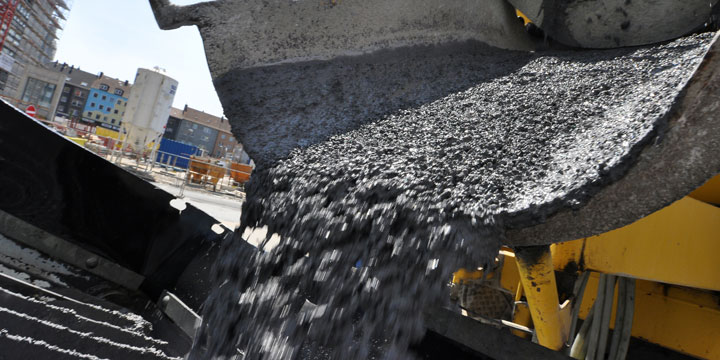
The question of substances being released from fresh concrete only arises in special applications where the fresh concrete already comes into contact with groundwater. At the start of hydration, there is no phase boundary between the water and the fresh cement paste, and soluble substances may not yet be incorporated into the hydration products. Therefore, cementitious materials may exhibit different leaching behaviour in their fresh state than in their solid state. It was therefore necessary to examine whether leaching during the processing phase must also be taken into account when assessing environmental compatibility if there is direct contact between the fresh, not yet hardened material and, for example, groundwater.
In a research project, existing test methods were put to the test and an assessment concept for fresh concrete leaching was developed. To this end, all relevant areas of application for fresh concrete leaching were covered in the tests and various cements and cement-based special binders were tested. First, the test was carried out using a fresh concrete stand test developed by RWTH Aachen University and compared with the standardised GLHC method according to DIN EN 16637-2, which was developed for granular products. The results show that the less complex and already standardised GLHC method can achieve results equivalent to those of the fresh concrete stand test.
Analogous to the assessment concept for the environmental compatibility of concrete, an installation situation in groundwater was modelled for the application of a cement suspension and a transfer function was derived. Based on the insignificance thresholds of the German Water Working Group (LAWA) and the modelling results, maximum permissible releases were derived in laboratory tests. Using this assessment standard, all formulations tested in the project and additional results available in the literature on fresh concrete release were evaluated. The maximum permissible releases for all substances and formulations were safely below the limits. From the research institutions' point of view, testing or regulation of fresh concrete release is therefore not necessary.