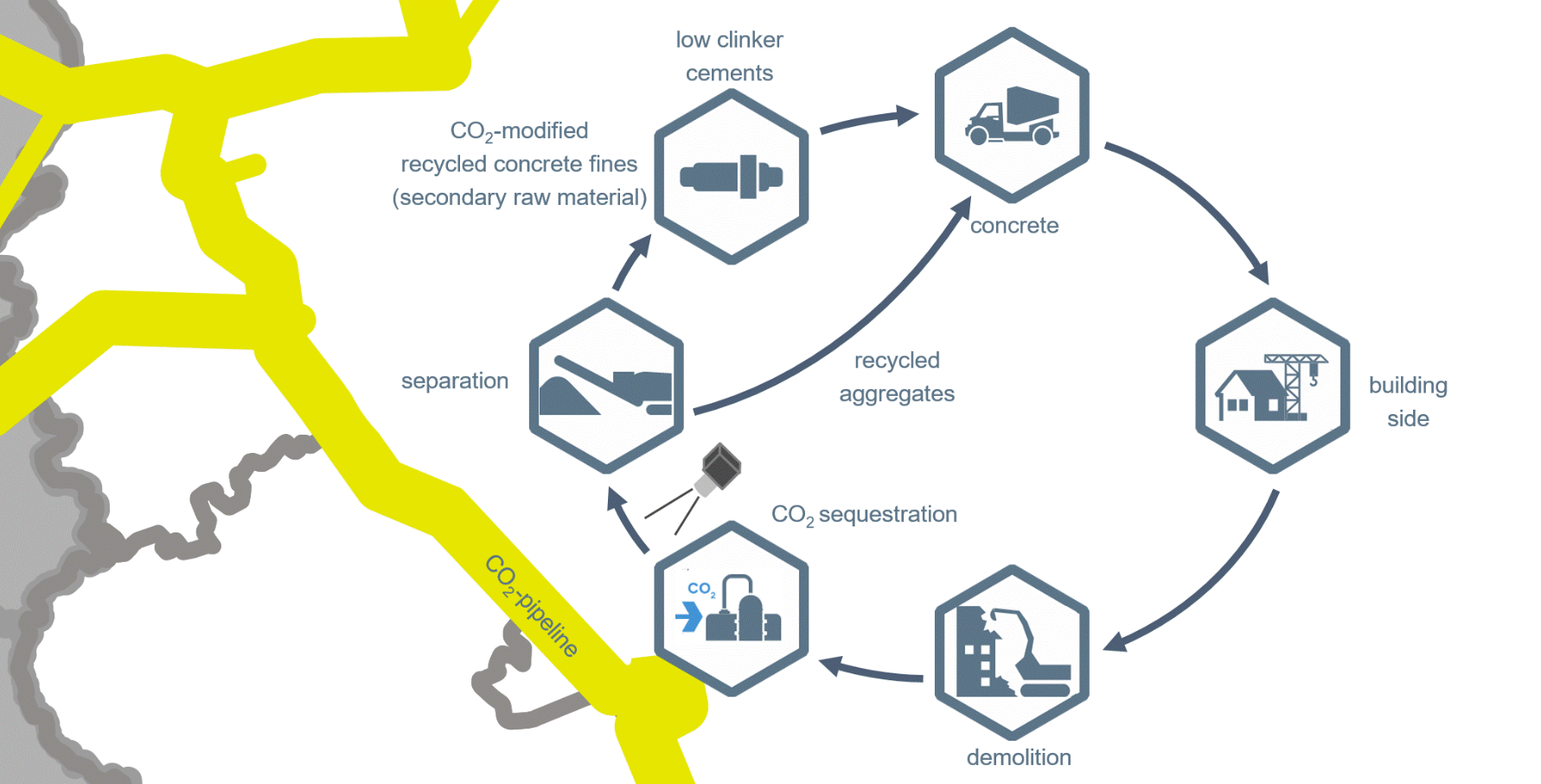
The ongoing transformation of the cement and concrete industry toward a circular economy requires continuous innovation in the reuse of existing construction materials to conserve natural resources. A key aspect is the selective separation of demolished concrete into its components, enabling the reuse of recycled aggregates and the utilisation of cement paste - ideally after CO₂ treatment and permanent binding - as a secondary raw material in new cements. In simplified terms, this approach involves two main steps: (i) separation of aggregates and cement paste, and (ii) accelerated carbonation of the cement paste.
This research project (project number 10.08.18.7-25.01) aims to use carbonation as a tool to improve the selective separation of concrete constituents. The approach is based on the interfacial transition zone (ITZ), enriched with calcium hydroxide, between aggregates and cement paste, which serves as a pathway for external media. By applying CO₂ in its dense phase above the critical point - highly penetrative due to the absence of surface tension - and exploiting the natural volume increase associated with the local conversion of hydroxide to carbonate, a modification of the ITZ is expected. This effect is intended to facilitate improved separation of aggregates and cement paste through targeted CO₂ treatment. The goal of the project is to evaluate the process and technical parameters of this innovative approach and to determine its transferability to different concrete mix designs.
The resulting knowledge (guideline) is intended to form the basis for the described process and thereby enable future CO₂ sequestration in demolished concrete using existing CO₂ in-frastructure (CO₂ concentrated for transport). Improved selective separation during concrete deconstruction will simplify the use of recycled materials and secondary raw materials in new construction, thereby enhancing sustainability in the building sector.