24.03.2025
News
Synergies in the integration of CO₂ capture systems on several production lines
Achieving climate neutrality in the cement and lime industries poses a particular challenge, given that the majority of CO₂ emissions are caused by raw material-related emissions from the decompo-sition of limestone. The capture and storage of CO₂ (carbon capture and storage, CCS) is therefore pivotal in enabling these industries to achieve climate neutrality. The selection of a suitable capture technology is contingent on site and plant-specific conditions. In many cases, multiple production lines or products exist which generate substantial CO₂ emissions.
Find out more
04.02.2025
Press release
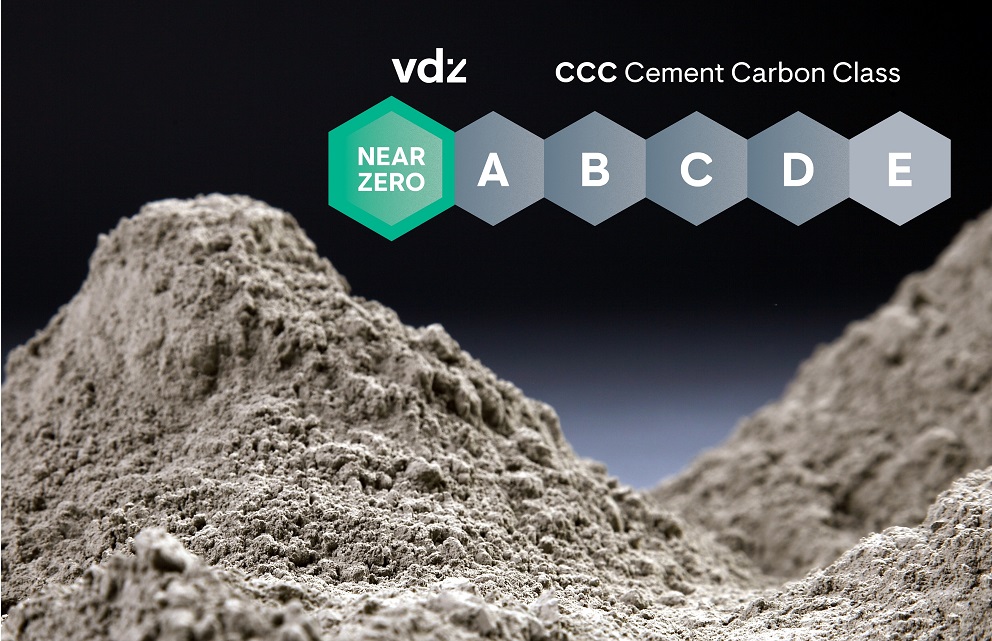
VDZ introduces CO₂ label for cement
In 2024, the German cement industry together with other stakeholders developed a definition of ‘green cements’ as part of a stakeholder process organised by the German Federal Ministry for Economic Affairs and Climate Action (BMWK), which sets thresholds for climate-friendly products. “However, the definition alone does not create demand. That's why VDZ has introduced a voluntary CO₂ label that makes the CO₂ footprint of products on the market easily recognisable and comparable in order to promote the use of green cements”, explains Christian Knell, President of the German Cement Works Association (VDZ). ”The new VDZ label is called Cement Carbon Class (CCC) and can be referred to in tenders so that the use of CO₂ reduced cements becomes standard in the construction sector”, Knell emphasises. The public sector is particularly interested in this when it comes to procurement – but private construction projects can also benefit from low-emission cements and concretes, for example in terms of sustainability certification or the granting of subsidies.
Find out more
06.11.2024
Press release
Shaping the transformation together – 9ᵗʰ International VDZ Congress opens
This afternoon, Christian Knell, President of the German Cement Works Association (VDZ), officially opened the 9ᵗʰ International VDZ Congress with over 600 participants in Düsseldorf: ”The cement and concrete industry is probably undergoing its biggest transformation ever. Step by step, we are decarbonising our value chain”, emphasised the VDZ President. “There is no alternative, we must deliver a net-zero cement and concrete value chain and we will deliver if we get the right framework conditions and the support of governments and society”. The VDZ Congress is the international scientific forum for the cement industry and its suppliers, addressing key challenges and developments to the sector. This year's focus is on shaping the transformation together, e.g. in the fields of carbon capture (CCUS), process technology, digitalisation and binder technology.
Find out more
01.10.2024
News
VDZ's environmental data 2023 published
In keeping with its established tradition, this year VDZ is once again providing a comprehensive overview of production and structural data, raw material and energy requirements and the current emissions of German cement manufacturers in this year's edition of the ‘Environmental data of the German cement industry’. In this way, the environmental data also illustrate how the cement industry is making progress in decarbonising cement production and conserving natural resources.
Find out more
26.07.2024
Opinion
VDZ statement on the draft implementing regulation updating the Monitoring and Reporting Regulation (MRR) in response to the revision of the European Emissions trading system (EU ETS)
In the context of the “Fit for 55” package of EU legislation, the ETS Directive has been revised with the EU target set out in the European Climate Law to reduce net greenhouse gas (GHG) emissions by 55% by 2030, compared to 1990 levels. Following this revision, the European Commission needs to update several regulatory acts for the implementation of the EU ETS. More on this in the following PDF file.
Find out more
19.06.2024
Press release
Requirements for a CO₂ infrastructure in Germany
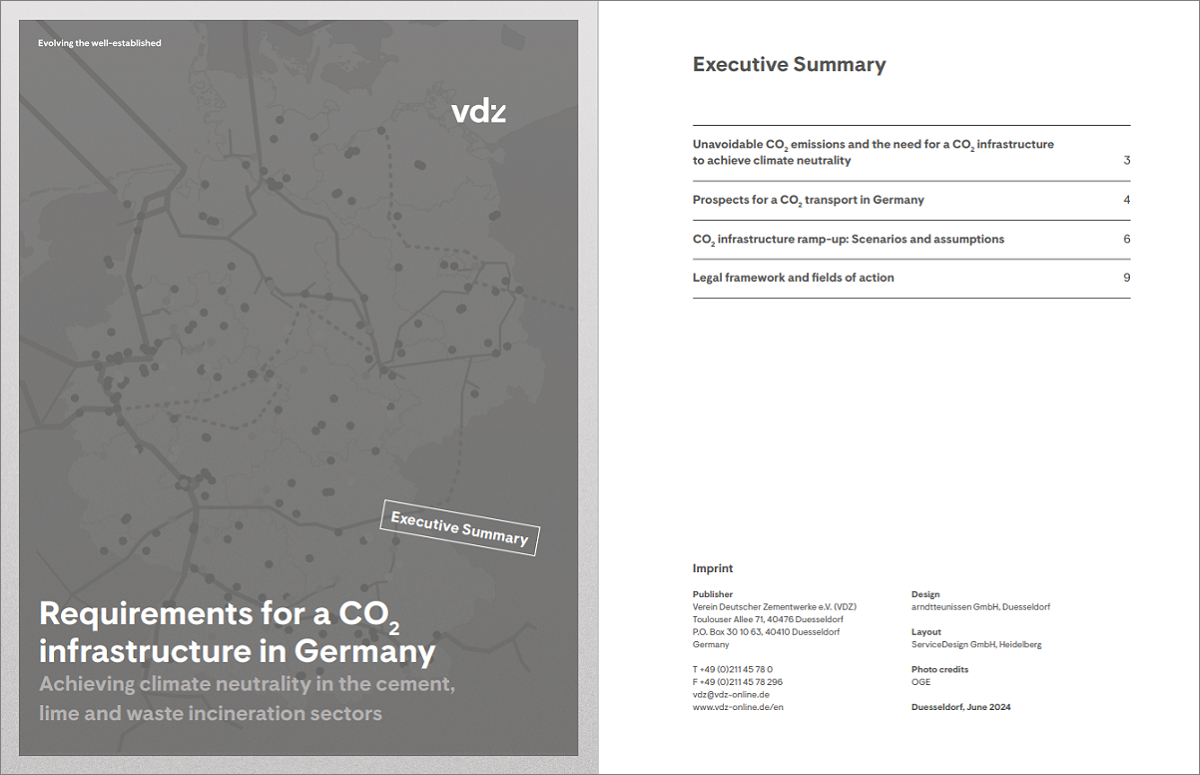
Due to the high proportion of unavoidable CO₂ emissions, there is no way around CO₂ capture, storage and utilisation when it comes to decarbonising the cement and lime industries and waste incineration. ”The development of a CO₂ infrastructure in Germany is essential for these industries”, says Christian Knell, President of the German Cement Works Association (VDZ). And time is pressing: Cement manufacturers and other industries in the EU emissions trading scheme must produce their products in a largely climate-neutral way by 2040. “To achieve this, companies need a CO₂ pipeline network by 2035 at the latest”, continues Knell. In a study, VDZ has analysed what a German CO₂ pipeline network could look like and what the requirements are for the CO₂ infrastructure. In order to make the results of the study accessible to an international audience, an English summary is now also available.
Find out more
09.04.2024
News
Partial oxyfuel - Separate calcination of raw meal to concentrate CO₂ in the exhaust gas
The capture of CO₂ and its subsequent use and storage are key elements of the cement industry's decarbonisation strategy. The separation of CO₂ from waste gas is an energy-intensive and complex process. This process can be made simpler and more efficient by achieving the highest possible CO₂ concentration in the flue gas. If the calcination of the raw meal is separated from the actual clinker burning process, this considerably facilitates the concentration of CO₂ in the flue gas and reduces the "contamination" of the CO₂ with (false) air.
Find out more
24.11.2023
News
Processing of EAF-slags for sustainable utilisation as cement main constituent
The research fields in the area of "cement and concrete" with a focus on their climate-neutral and sustainable production are and will remain an important topic within the cement industry. VDZ is therefore pursuing a number of promising approaches which, if technically and economically suitable, can be further developed to an important component of the decarbonisation strategy. In addition to the known processes for CO₂ capture and utilisation, there are currently also a number of opportunities in the field of mechanical process engineering to optimise the sustainable use of main cement constituents and to further reduce the CO₂ footprint of future relevant and clinker-efficient cement types. Calcined clays are currently the focus of research. However, EAF-slags also offer interesting potential with regard to more climate-friendly and sustainable cement production, which will be examined and considered in more detail in future research projects.
Find out more
19.09.2023
News
VDZ represented at the 16th International Congress on the Chemistry of Cement (ICCC) 2023 in Bangkok
The 16th International Congress on the Chemistry of Cement (ICCC) 2023 in Bangkok is in full swing. Dr Martin Schneider was pleased to give a keynote speech on the cement plant of tomorrow which was met with great interest from the participants. Aiming at net-zero CO₂ emissions by 2050, the cement and concrete sector is going through its biggest transformation ever. Cement plants will have to implement all CO₂ abatement and saving measures – both conventional and breakthrough – to the best extent possible.
Find out more
07.08.2023
News
Shaft kiln for calcining raw meal for clinker production in the cement industry - an efficient technology for concentrating CO₂ in the waste gas
The capture of CO₂ and its subsequent use and storage are essential elements of the cement industry's decarbonisation strategy. The capture of CO₂ from the flue gas is energy-intensive and complex. It can be carried out more easily and efficiently by maximizing the CO₂ concentration in the flue gas. The separation of the calcination of the limestone in the raw meal from the burning process to produce clinker phases simplifies the accumulation of CO₂ in the flue gas significantly.
Find out more